
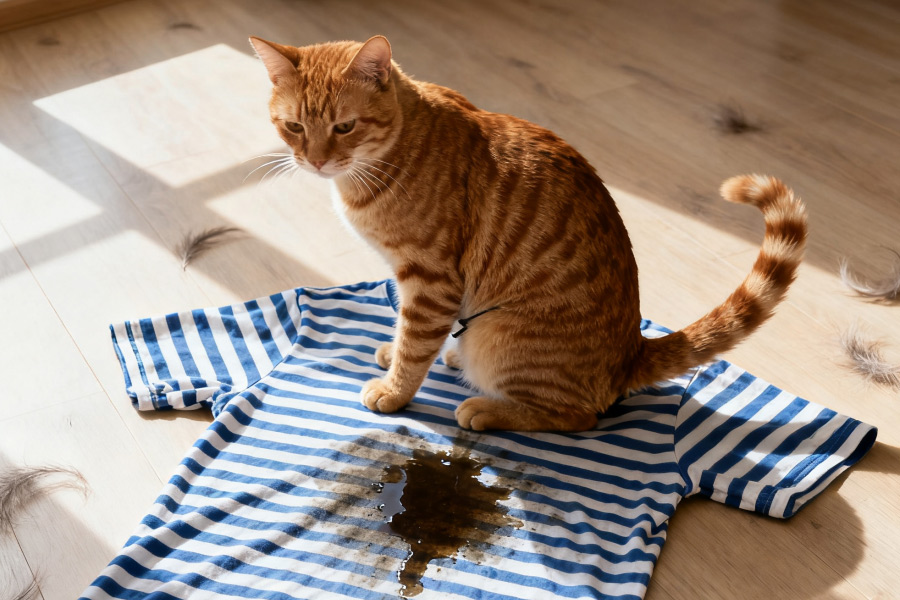
Why Is My Cat Peeing on My Clothes? An In-Depth Guide to Causes and Solutions
Finding that your cat has peed on your favorite sweater, your gym bag, or the pile of clothes on your floor is frustrating, disheartening, and frankly, it stinks. Your first reaction might be to think, “Are they doing this to spite me?”
Please know this: Cats do not pee out of spite or revenge. This behavior is a powerful distress signal. When your cat chooses your clothes, of all places, they are sending you a message that is both complex and clear: “I am not okay.”
This guide will help you decode that message. We will dive deep into the feline mind, explore the unique significance of your scent, and provide a step-by-step plan to solve this problem for good.
The Core Reason: It’s All About Your Scent
To understand why your cat targets your clothes, you must first understand one crucial fact: Your scent is your cat’s anchor. It is the smell of safety, security, and comfort.
When your cat urinates on your clothes, they are engaging in “mingling scents.” By mixing their urine (which contains their unique scent signature) with your potent, comforting smell, they are creating a giant, olfactory security blanket. It’s their way of saying, “You are mine, I am yours, and this makes me feel safe.”
The problem arises when this natural, comforting instinct is triggered by an underlying issue. Let’s diagnose what that issue is.
The Diagnostic Triad: The Three Root Causes
To effectively solve this, you must investigate three key areas. Follow this path in order—do not skip steps.
1. The Medical Emergency: Ruling Out Pain and Discomfort
This is always the first and most critical step. A cat experiencing pain while urinating will often develop a negative association with their litter box. They might then seek out soft, absorbent surfaces (like your pile of clothes) that are kinder on their body and that they don’t associate with the pain.
Common Medical Conditions:
- Feline Idiopathic Cystitis (FIC): A stress-related inflammation of the bladder wall, very common in young cats.
- Urinary Tract Infection (UTI): Causes a burning sensation and urgency.
- Bladder Stones or Crystals: These irritate the bladder lining, making urination painful.
- Arthritis: Makes stepping into a high-sided litter box painful.
Your Action Plan:
- Schedule a Veterinary Appointment Immediately. Even if your cat seems fine otherwise.
- Request a Urinalysis. This is non-negotiable. It will check for crystals, blood, infection, and pH levels.
- Describe the Behavior Precisely. Tell your vet, “My cat is specifically seeking out my soft, smelly clothes to urinate on.” This is a crucial diagnostic clue.
2. The Litter Box Aversion: “My Toilet is Unacceptable”
If your cat gets a clean bill of health, the problem is likely the litter box setup. Cats are fastidious creatures with strong preferences. Your clothes may simply be a more appealing alternative.
Conduct the “Litter Box Audit”:
- Cleanliness: Is it scooped at least once a day? Is it deep-cleaned weekly? A dirty box is the #1 reason cats boycott their toilet.
- Number: In a multi-cat home, the golden rule is “one litter box per cat, plus one extra.” This prevents resource guarding and gives each cat options.
- Location: Is it in a quiet, low-traffic area? Is it away from noisy appliances (like a washing machine) and their food/water bowls? A cat that feels exposed or startled won’t use the box.
- The Litter Itself: Have you recently changed the type? Most cats prefer unscented, fine-grained, clumping litter. Perfumes are overwhelming to their sensitive noses.
- The Box: Is it large enough? It should be at least 1.5 times the length of your cat. Is it covered? Hoods trap odor and make cats feel vulnerable to ambush.
Pro Tip: Place a brand-new, pristine litter box filled with a cat-attractive litter (like unscented clumping clay) right next to the spot where they’ve been targeting your clothes. This makes the “right” choice incredibly easy.
3. The Stress & Anxiety Factor: “I Feel Insecure”
This is the most complex reason and often the primary driver when the target is your scent-soaked belongings. Your cat is seeking comfort because they feel anxious.
Common Stressors:
- Separation Anxiety/Change in Routine: Have you started working longer hours? Traveled recently? Your clothes are your proxy, and urinating on them is a coping mechanism for your absence.
- New Scents: Did you come home smelling like another animal? A new perfume? A friend’s house? Your cat may be trying to “reclaim” you by covering the foreign smells.
- Environmental Changes: A new pet, a new baby, a move, or even new furniture can disrupt your cat’s sense of security.
- Multi-Cat Household Tension: Even if there’s no overt fighting, subtle bullying (like one cat blocking access to resources) can cause immense stress to the victim.
- Outdoor Threats: The sight, sound, or smell of a neighborhood cat outside the window can trigger indoor territorial anxiety.
The Action Plan: How to Stop This For Good
Phase 1: Immediate Management
- Eliminate the Opportunity: This is non-negotiable. Get a laundry hamper with a secure lid. Never leave clothes, shoes, or gym bags on the floor. Make your dirty clothes inaccessible 24/7.
- Change the “Function” of the Area: After a thorough clean (see below), place your cat’s food bowl, water fountain, or a favorite scratching post in the previously soiled spot. Cats will not urinate where they eat or play.
Phase 2: Thorough Cleaning
If you don’t completely eliminate the odor, your cat will be drawn back to the same spot.
- You MUST use an enzymatic cleaner. Regular cleaners or bleach only mask the smell for human noses. They do not break down the uric acid crystals in cat urine, which a cat’s sensitive nose can still detect.
- Steps:
- Blot up as much urine as possible.
- Soak the area thoroughly with the enzymatic cleaner.
- Let it air dry completely, following product instructions.
- Wash clothing as normal, and consider adding an enzymatic laundry booster.
Phase 3: Behavioral and Environmental Solutions
- Use Feliway or another synthetic feline pheromone diffuser. These products release “calming messages” that mimic the facial pheromones cats use to mark their territory as safe. Plug it into the room where the incidents occur.
- Increase Positive Interactions: Schedule dedicated, predictable playtime each day using a wand toy. This builds confidence, burns anxious energy, and strengthens your bond in a positive way.
- Create Secure Spaces: Provide high perches (cat trees, shelves) and hiding spots (covered beds, boxes). Giving your cat an “escape route” and a vantage point can significantly reduce anxiety.
- Manage Multi-Cat Dynamics: Ensure resources (food, water, beds, litter boxes) are spread throughout the house to prevent competition.
What NOT to Do
- NEVER punish your cat. Rubbing their nose in it, yelling, or any other form of punishment will only make them more anxious and fearful of you. This will worsen the problem, likely causing them to urinate in hidden, hard-to-find places.
- Do not use ammonia-based cleaners. Ammonia is a component of urine and can actually attract your cat back to the spot.
Final Thoughts
Solving your cat’s inappropriate urination requires patience, detective work, and compassion. See yourself as your cat’s advocate, not their adversary.
Your roadmap is clear:
- Rule out medical issues with your vet.
- Become obsessed with litter box perfection.
- Manage the environment by securing your clothes and using enzymatic cleaners.
- Address underlying anxiety with pheromones, play, and environmental enrichment.
By understanding that your cat is crying for help on your clothes—the very items that smell most strongly of you—you can respond with the empathy and systematic action needed to restore peace and cleanliness to your home.