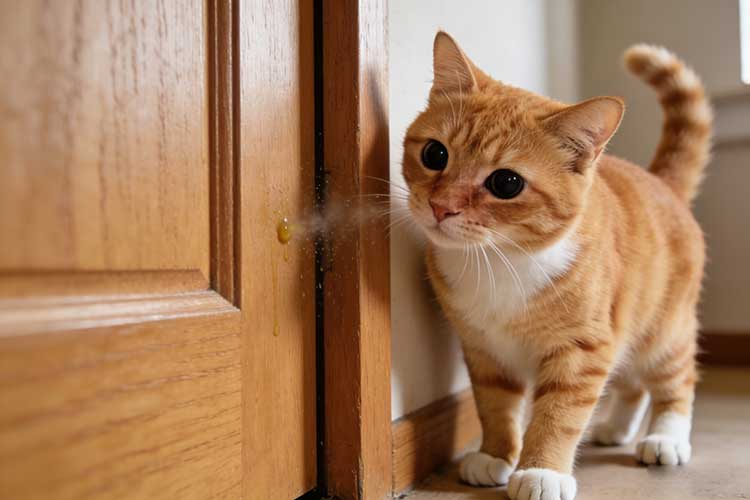
- What Does Male Cat Spray Smell Like?
- When Do Male Cats Start Spraying? The 3 “Clocks” That Give the Answer
- Do Male Cats Spray After Being Fixed? Neutering Facts & Myths
- Why do male cats spray? The 4 Root Causes Explained
- How Often Do Male Cats Spray? Frequency Before & After Neutering
- How to Stop a Male Cat From Spraying: A Vet-Approved 4-Step Plan
- Quick FAQ: Male Cat Spraying Solved
- Related Articles
“Ask ‘Do male cats spray urine?’ It’s like asking, ‘Do men shave?’ ”
The straightforward answer: Yes, and it’s very common. But that statement is only half-true. A more accurate description is: Male cats do spray urine, but each male cat’s “motivation formula” for spraying is entirely different. Unneutered young males, recently neutered adult males, and elderly neutered males—their reasons for spraying, frequency, and solutions are worlds apart.
What Does Male Cat Spray Smell Like?
Male cats’ urine sprays emit an intensely pungent, overpowering odor that lingers stubbornly. What does a male cat spray smell like? The stench is truly beyond description—a blend of skunk spray and rotting cabbage, and the musty stench of an old public restroom.
This odor stems from anal gland secretions and pheromones in the urine, particularly felinine—that decomposition, of these compounds produces sulfur-containing substances that give off a putrid smell. Unneutered males emit an especially potent scent, as testosterone intensifies this odor production.
Once the unmistakable cat pee smell from a male cat sets into fabrics, walls, or furniture, simple water cleaning is rarely enough. If not thoroughly eradicated, this odor will repeatedly emit a sour, musty reminder of its presence.
When Do Male Cats Start Spraying? The 3 “Clocks” That Give the Answer
“When do male cats start spraying urine?” The answer lies hidden within three different clocks.
Clock A: The Physiological Clock – What Age Do Male Cats Start Spraying?
- 5-8 Months: Male Kitten Puberty Kicks In
This is the most typical window for male cats to start spraying. Testosterone levels surge, and instincts are “activated.” If your male kitten suddenly shows interest in corners during this age range, don’t be surprised—and stop asking “What age does a male cat start to spray?” He’s already begun—his biological clock has started ticking.
Male cats entering puberty instinctively begin to spray urine to mark territory, announce their presence to females, and compete with other males. Over 90% of unneutered male cats exhibit urine spraying behavior. - 1-3 years: Mature Male Consolidation
Unneutered males reach peak spraying during this phase, with territory marking expanding from indoors to doorways and yards. If a neutered male cat sprays during this stage, it’s often linked to social stress (like competition among multiple cats) or anxiety. - 7+ years: Transition into Senior Male Cat Years
If an older male cat suddenly starts or resumes spraying, medical evaluation must be the priority! Joint pain, cognitive decline, and kidney disease can all cause behavioral changes.
Clock B: The Event Trigger Clock – “When” Means “After What Happens”
After a new cat arrives at home (especially another male cat), after moving, renovating, or rearranging furniture, after a new stray cat appears outside the window, after a new family member (baby, partner) moves in, or after your business trips or work hours suddenly increase—these environmental changes can cause male cats to start spraying.
Clock C: The Neutering Clock – Your Most Critical Intervention
- This is the most actionable part of answering “When do male cats start spraying?”Ideally, neutering should be completed before the first signs of spraying appear (around 5-6 months of age). This is a “preventative surgery” that avoids behavioral fixation.
- However, most of the time, we often only perform neutering after noticing spraying behavior in male cats. At this point, it’s crucial to understand: Hormone-driven urges gradually diminish over weeks to months, and established habits may require additional intervention to eliminate. Consequently, post-neuter spraying in the home remains relatively common.
- Important reminder: Neutering isn’t a time-rewinding magic spell. It addresses future hormone-driven urges but has a limited effect on learned behaviors and current environmental stressors.
Do Male Cats Spray After Being Fixed? Neutering Facts & Myths
In the vast majority of cases, neutered male cats will stop spraying urine. Neutering is the most effective solution for addressing spraying behavior in male cats. If you encounter a neutered male cat spraying in house, please remain patient, systematically identify the cause, and address it.
In good health and living in a stable, low-stress environment, do male cats spray after being fixed? It’s possible, but the probability of spraying is extremely low if they were neutered during kittenhood.
Male cat spraying (territorial marking) is primarily driven by sex hormones (especially testosterone). It serves to declare territory, warn other males, and attract females. Neutering removes the testicles, causing testosterone levels to drop significantly. As hormones diminish, the cat’s territorial declaration and mating instincts greatly weaken or disappear entirely. Therefore, neutered male cat spraying in the house is typically stopped.
So, will my cat stop spraying after being neutered? It’s possible. Approximately 10% of neutered males may retain marking behavior for various reasons. These include habitual spraying, stress/anxiety-related spraying, or pathological causes. Identifying the specific reason for a neutered male cat spraying requires step-by-step investigation.
Why do male cats spray? The 4 Root Causes Explained
Hormone-Driven Spraying (The Classic Cause)
- Protagonists: Unneutered adolescent and adult male cats
- Causative: Surging testosterone levels
- Male cats’ Behavioral Language: “This is my territory! All females belong to me! Other males, get lost!”
- Spraying Characteristics: High frequency, numerous marking spots, aggressive posture, strongest odor
- Good news: This is the easiest to resolve—neutering yields immediate results.
Stress & Anxiety Spraying (Common in Neutered Cats)
- Protagonists: Neutered male cats (especially sensitive personalities—check if your male cat has a sensitive disposition)
- Causative: Environmental changes, resource competition, lack of security
- Male cats’ Behavioral Language: Feeling uneasy lately… I need to surround myself with familiar scents to feel secure.”
- Spraying Characteristics: Often occurs after specific stressors (moving, new household members, outdoor cats outside windows), may be accompanied by other anxious behaviors (excessive grooming, hiding)
- Key Insight: This is also why neutered male cats spray.
Habit-Based Spraying (When “Muscle Memory” Takes Over)
- Protagonists: Male cats neutered later in life (e.g., those neutered after exhibiting spraying behavior for a period starting around age one)
- Causative: A long-established spraying habit formed through repeated behavior.
- Male cats’ Behavioral Language: “Ugh, I don’t know why, but I just feel like spraying here.”
- Spraying Characteristics: Occurs at fixed locations and times, resembling a “ritual.” Hormones are gone, but the spraying “program” still runs on autopilot.
Medical-Related Spraying (Rule This Out First!)
- Protagonists: Male cats of any age or condition
- Causative: Pain, infection, stones, kidney issues
- Male cats’ Behavioral Language: “I’m in pain/I can’t hold it/I can’t control it!”
- Red Alert: Accompanied by frequent urination, blood in urine, howling, or excessive licking of the urethral opening. Male cats have narrow urethras—urinary obstruction is a life-threatening emergency within 24 hours!
If a male cat suddenly begins urinating everywhere around the house, this is typically a sign of a medical emergency—such as a urinary tract infection or blockage—rather than simple marking behavior. Especially when accompanied by vocalization or frequent trips to the litter box, immediate veterinary attention is required.
How Often Do Male Cats Spray? Frequency Before & After Neutering
The frequency of urine spraying (marking behavior) in male cats primarily depends on their hormone levels, environmental stress, and social status. Sexually mature, unneutered males (typically over 6 months old) possess a strong instinct to mark territory and attract mates with urine, occurring almost daily.
How often do male cats spray during mating season? The answer may surprise you: Especially when nearby female cats are in heat, male cats’ spraying frequency surges dramatically—potentially multiple times daily—to declare territory, intimidate rival males, and signal readiness to mate to females.
How often do neutered male cats spray? For the vast majority of male cats, neutering (removal of the testicles) drastically reduces sex hormone levels, leading to a significant decrease or complete cessation of spraying behavior. Ideally, about 90% of neutered males stop spraying altogether. If a neutered male continues to spray, it’s usually triggered by environmental stress or anxiety. The frequency becomes unpredictable, often occurring only when specific triggers are present.
How to Stop a Male Cat From Spraying: A Vet-Approved 4-Step Plan
Step 1: The Non-Negotiable Vet Visit (Rule Out Medical Issues)
Under all circumstances, consult a veterinarian first. This step is non-negotiable, whether you’re dealing with a cat peeing outside the litter box, a male cat spraying, or even the question of “do female cats spray?” Conduct a urinalysis to rule out cystitis, kidney stones, or urinary tract infections. Medical issues are a common root cause for all forms of inappropriate elimination, and they must be addressed before any behavioral modification.
The Neutering Decision (Address the Hormonal Root)
If your male cat is unneutered, this is your top priority and most effective solution. After neutering, hormonal changes take time to subside. Behavioral adjustments may require 1-3 months, during which environmental modifications will enhance results.
Environmental Fixes – Eliminate Stress for Good
- Space and Resources (Your Cat’s “Fixed Assets”)
Litter Box: Follow the N+1 rule. Maintain extreme cleanliness. Experiment with different litters (some male cats dislike scented or uncomfortable textures).
Vertical Space: Cat trees, top of cabinets. Elevated spots make your male cat feel secure and reduce anxiety.
Resource Separation: Place litter boxes, food bowls, and water bowls separately—never in a straight line. - Socialization and Safety (Cats’ “Interpersonal Relationships”)
Multi-cat households: Ensure each male cat has escape routes and hiding spots that don’t require sharing.
Window threats: Use frosted window film, curtains, or pile clutter (like foil, which cats dislike stepping on) on windowsills you don’t want cats to access to block “rival stares.”.
Exclusive Time: Set aside daily uninterrupted play or petting sessions with your male cat to provide ample security and affection, strengthening your bond.
Behavior Correction—Reinforcing Good Habits
- 1. Thorough Cleaning (Otherwise All Efforts Are Wasted)
Enzyme cleaners are essential! Regular cleaners are ineffective. Areas sprayed by male cats must be soaked and cleaned thoroughly. After air-drying, temporarily cover them with aluminum foil or double-sided tape (cats dislike the texture). - 2. Positive Redirection
Place food bowls, water bowls, or a cat bed near common spraying spots. Male cats typically avoid soiling their “dining room” or “bedroom.”
Immediately reward him with treats or petting after using the litter box.
Consider pheromones: Feliway Classic diffusers may help alleviate anxiety. - 3. Absolutely Do Not Do
Do not scold, spray water, or force-sniff: This only increases anxiety and associates “you” with fear, potentially leading to more covert spraying.
Do not frequently switch punishment methods: This only adds unpredictability and intensifies stress.
Please remember, when your male cat sprays, it’s not a challenge to you. That “bossy CEO” or “anxious boy” is simply expressing deep-seated stress or instinct in the only way he knows how.
Quick FAQ: Male Cat Spraying Solved
Related Articles
-

-
 Do Female Cats Spray? The Complete Guide to Why & How to Stop It Wondering if female cats spray? The answer is yes. Discover the surprising reasons why female cats spray, how it differs from male cats, and proven methods to stop this behavior. Get answers to “can female cats spray?” and “do girl cats spray?” here.
 -

-