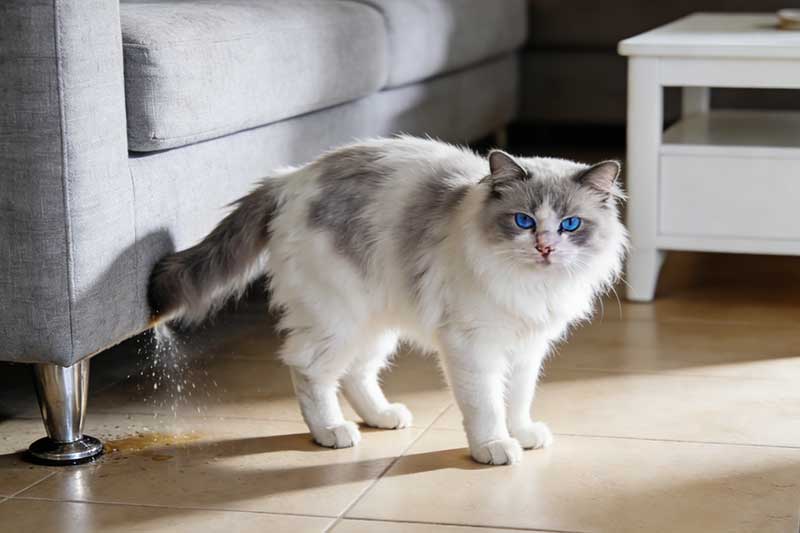
Reading Guide: Neutering can resolve over 90% of hormone-driven urine spraying behaviors. However, if spraying became habitual before neutering or is triggered by stress, illness, or environmental factors, it may persist after the procedure. Solutions require a combination of medical evaluation, environmental adjustments, and behavioral correction.
Can Neutered Cats Spray? (And Will It Stop?)
When you complain to friends or colleagues about your cat constantly spraying urine around the house, they’ll likely all advise: “Get it neutered ASAP!” So, does spaying a cat stop them from peeing everywhere? Can neutered cats spray? Neutered male cats can still spray urine. While neutering significantly reduces the likelihood of spraying (by about 90%), it doesn’t eliminate it. To resolve this issue, please refer to our ultimate guide on cat urination problems: Why is my cat peeing outside the litter box?
In fact, both neutered male cats and spayed female cats can and do spray urine under certain circumstances. So, yes, even a fixed cat can spray. Spaying/neutering (whether for males or females) is the most effective way to reduce spraying, but it’s not a foolproof “delete button.”
According to 2025 data from the American Veterinary Medical Association:
- Unneutered male cats: 90% will spray urine
- Neutered male cats: 10-15% will still spray urine
- Spayed female cats: <5% will spray urine
This indicates that neutering resolves 85-90% of urine spraying issues, but not 100%.
Do Neutered Male or Spayed Female Cats Spray More?
Yes, neutered male cats are far more likely and inclined to spray than spayed females. While neutering significantly reduces spraying behavior in both males and females, the instinct to spray remains stronger in males.
Due to their innate, stronger territorial instincts, neutered males are more likely to continue spraying even after surgery. Studies and veterinary reports consistently show that spraying issues are reported far more frequently in households with neutered males than with spayed females.
In fixed cats, spraying is no longer primarily a sexual signal (as it is in intact cats), but rather becomes a form of communication related to territory, stress, or environmental factors. This territorial nature makes the behavior more persistent in males.
Why Do Neutered Male Cats Still Spray?
Let’s revisit our understanding of cat neutering and spraying behavior: What exactly does neutering change? What does it not change?
What Neutering Changes (The Good News)
It significantly reduces sex hormone levels: Neutering, by removing the male cat’s gonads (testicles), fundamentally eliminates heat behaviors driven by sex hormones (testosterone) and the territory-marking spraying directly associated with reproductive competition (the male cat’s “I need to find a mate” type of marking).For a deeper dive into male-specific spraying causes and solutions, check out: Why Do Male Cats Spray? When & How to Stop It.
What Neutering Doesn’t Change (The Real Reasons They Still Spray)
Although hormone levels drop significantly, territorial anxiety and established habits can take over. You can think of it as shifting from “marking to find a mate” to “marking to defend my turf.”
- Stressors in the environment: That bold stray cat outside, the roommate cat that always fights over food and territory, the strong-smelling cleaner you just started using… These sources of territorial anxiety and stress don’t disappear with neutering, which is why a cat may still spray after being neutered.
- Ingrained “muscle memory”: Male cats neutered before developing spraying behavior (typically before 6-8 months) have a 90-95% chance of never exhibiting spraying. If spraying habits formed before neutering, the procedure removes the hormonal trigger but leaves the behavioral pattern intact, so the cat continues to spray after neutering。
- Potential health issues: Cystitis, urinary tract infections, stones… These conditions won’t resolve on their own due to neutering. In fact, stress-induced spraying itself can trigger cystitis, creating a vicious cycle.
Neutered male cats typically have a much milder urine odor than unneutered cats, as the primary sex hormones are removed. However, if the odor remains strong, it may be necessary to consider whether cleaning urine stains and odor is thorough enough or if there are other health issues.
So, cats can still spray urine after being neutered
Neutering resolves hormone-driven spraying but cannot completely eliminate stress-related or habitual spraying.
Spraying is not only a sexual signal but also a broader form of communication. When cats feel stressed, anxious, or ill, they may still spray to mark territory or release emotional tension.
According to data from the International Feline Behavior Association, among cats exhibiting urine spraying behavior after neutering:
Why Would a Spayed Female Cat Spray?
For neutered male cats, spraying is typically a residual or evolved form of “sexual marking” behavior. For spayed female cats, spraying is almost entirely unrelated to ‘sex’ and instead serves as a 100% “stress red flag.”
What Spaying Changes for Female Cats
Significantly reduces estrogen levels: Spaying eliminates the ovaries, fundamentally removing estrogen-induced “sexual marking” (where female cats spray urine as a mating signal), which consequently decreases significantly or disappears entirely.
Why Spayed Female Cats Might Still Spray
When my female cat first exhibited suspected spraying behavior, I was more shocked than if I’d seen a male cat spray, as it’s commonly believed to be “exclusively a male cat’s trait.” But it turned out I was being naive.
While spayed female cat spraying is relatively rare, it can indeed occur under specific circumstances. If a spayed female cat does spray, there’s likely a clear medical or environmental cause that needs addressing.
- Medical problems (the most common cause): These include urinary tract infections, bladder stones or crystals, kidney disease, diabetes or other metabolic disorders, and arthritis or pain that makes using the litter box difficult. All of these are urgent medical conditions that can cause either spraying or inappropriate peeing everywhere in spayed female cats.
- Extreme environmental stressors: Severe conflicts with other household pets, overcrowding in multi-cat households (too many cats, too little space), traumatic events or chronic anxiety, lack of sufficient resources or safe spaces—these pressures can spraying in otherwise healthy spayed females.
- Inadequate Litter Box Conditions: Dirty or poorly maintained litter boxes, unsuitable litter types or locations, insufficient litter boxes in multi-cat households—these anxieties can trigger spraying in female cats, essentially screaming, “I can’t take it anymore!”
Important Note: Female cats spray urine far less frequently than males in statistical terms. Therefore, when it does occur, it should be regarded as a serious environmental or social issue requiring your immediate investigation.
How to Stop a Cat From Spraying After Being Neutered or Spayed?
- See a Veterinarian
Set aside all behavioral theories and begin with a thorough physical exam, especially a comprehensive examination of the urinary system. Rule out medical issues like cystitis, infections, or stones—this is the foundation for all subsequent actions. Don’t play doctor.
If you notice any unusual bathroom habits in your cat, always consult your veterinarian as your first step.
- Become a “Sherlock Holmes” and understand your neutered cat’s spraying
Observe when and where the spraying occurs. Is it near a window? (Possibly spotting an intruding cat) Near new furniture? (Environmental change) Near another cat’s food bowl? (Resource competition) These observations are crucial clues to solving the mystery. - Create Vertical Space
Cat trees and shelves make cats feel secure, easing territorial anxiety. - Manage Multi-Cat Relationships
If cats are tense, they may need reintroduction or their own “safe zones.” - Use pheromones
Products like Feliway, which mimic feline facial pheromones, release calming signals to help ease anxiety (results vary among cats, but it’s worth trying). - Thoroughly clean without leaving scents
Soak contaminated areas completely. eliminate both the smell and the stain of cat urine. Cats will reinforce the behavior if they detect lingering odors. - Patience and Positive Redirection
Avoid punishment! Punishment increases stress and worsens the problem. After cleaning, place food bowls, toys, or scratching posts in the area to transform the “negative marking spot” into a “positive activity spot.” Provide more interaction and playtime to tire your cat out and reduce stress. - 1-3 years: Mature Male Consolidation
Unneutered males reach peak spraying during this phase, with territory marking expanding from indoors to doorways and yards.If a neutered male cat sprays during this stage, it’s often linked to social stress (like competition among multiple cats) or anxiety.
So, do cats stop spraying after being fixed? In most cases, yes, but if the behavior persists, follow these steps.
After writing all this, what I most want to tell you is: If your neutered cat still sprays urine, it’s not your fault, nor is it necessarily a “behavioral issue.”
Do neutered/spayed cats spray? Why is my neutered cat spraying? The answer to this question is actually a key. It unlocks a clearer map to your cat’s inner world—what fears it holds, where its sense of security comes from, and how you can create a truly relaxing home for it. Remember, spraying is one specific type of inappropriate elimination. For a full spectrum of causes and fixes, return to our comprehensive resource: Cat Peeing Outside Litter Box? 3 Reasons & Vet-Approved Fixes.
Quick FAQ: Spraying in Fixed Cats
Related Articles
-

-

-
 Do Female Cats Spray? The Complete Guide to Why & How to Stop It Wondering if female cats spray? The answer is yes. Discover the surprising reasons why female cats spray, how it differs from male cats, and proven methods to stop this behavior. Get answers to “can female cats spray?” and “do girl cats spray?” here.
 -