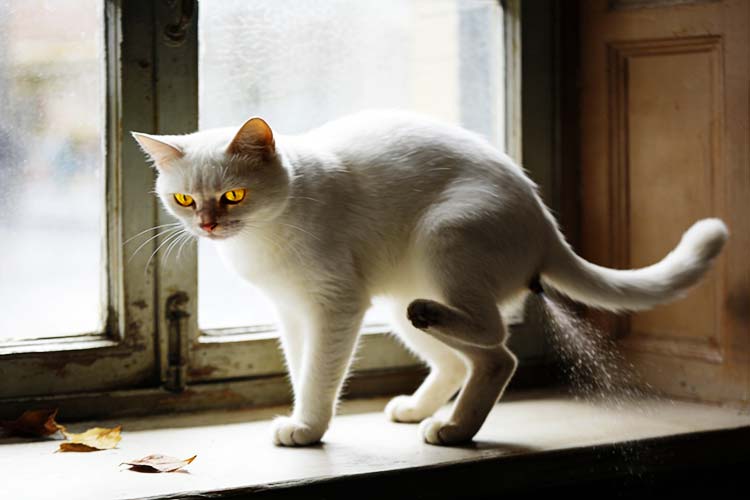
- Yes, Female Cats Spray – Here’s What You’re Seeing
- Do Female Cats Spray When in Heat? The Hormone-Driven Truth
- Why Do Female Cats Spray?
- Why Is My Female Cat Spraying? 6 Hidden Reasons Decoded
- How Often Do Female Cats Spray? Frequency Explained
- How to Stop a Female Cat from Spraying: A 4-Stage Action Plan
- Multi-Cat Households & Female Cats Spraying: "The Ladies' War"
- Spraying by Spayed Female Cats: “Persistent Habit”
- Sudden Spraying in Senior Female Cats
- Quick FAQ on Female Cat Spraying
- Related Articles
When you first discover your female cat spraying urine on the sofa legs, your initial reaction might be: “No way, do female cats spray?” But after consulting your vet: “Can female cats spray? Absolutely. And female cats’ spraying is even more concerning than males.
If you’re puzzled by urine marks on your walls or furniture corners, this article is for you. This isn’t a dry science article—it’s a firsthand account of pitfalls and a troubleshooting guide from someone who’s been there.
Yes, Female Cats Spray – Here’s What You’re Seeing
Can female cats spray? Yes, female cats absolutely spray urine—this might challenge your perception of them. “We often label female cats as ‘quiet’ and ‘well-behaved,’ forgetting they’re still cats who express anxiety and stress.”
Busting the Top 3 Myths About Female Cat Spraying
“Only male cats spray to mark territory” — WRONG! Female cats spray, and it’s more common than you think.
“Female cats spray when they’re in heat” — WRONG! For spayed females, 90% of spraying stems from stress.
“She’s spraying to get back at me/target me” — Wrong! Cats lack the concept of ‘revenge’; they only possess a “cry for help” instinct.
In behavioral clinic cases, approximately 25% of spraying incidents involve female cats. However, this number is severely underreported, as many owners mistakenly attribute female feline spraying to general issues of cat peeing outside litter box, such as “accidental urination,” “poor litter box hygiene,” or “age-related incontinence.”
Do Female Cats Spray When in Heat? The Hormone-Driven Truth
Female cats gradually reach sexual maturity between 5 and 10 months of age. During this process, hormonal changes trigger instinctive urine spraying behavior, releasing scent signals to attract potential mates. This behavior typically marks the onset of estrus, the most common and typical scenario for urine spraying in healthy, unspayed female cats.
So next time you ask, “Do girl cats spray when in heat?”—do you assume only male cats spray during mating season, while females don’t? In fact, female cats spraying urine during estrus is a hormone-driven, purposeful instinctive behavior.
The scent of urine sprayed by a female cat in heat is more intense and pungent than usual, a result of increased pheromone concentration. This allows her to signal to nearby males from a distance that she is receptive to mating. She may spray urine in prominent locations like territorial boundaries or near doors and windows to maximize scent dispersion. During the several days of her estrus cycle, urine spraying may occur frequently, becoming a significant part of her daily routine.
Why Do Female Cats Spray?
So why exactly do girl cats spray? The answer is entirely different from why male cats spray. A male cat’s spray is like declaring, “This territory is mine!” A female cat’s spray is more like a whisper: “Mom, I’m under so much stress, I can barely hold on.”
Female cats can’t speak, so they rely on spraying to leave unique scent marks for communication. Each sprayed spot is a “scent mail” we must learn to decode.
First, confirm you’re witnessing actual spraying. If you’ve read our Guide Cat Spraying, you know the first step is always: rule out medical issues. A female cat with cystitis may spray due to painful urination, adopting a posture that mimics the act of spraying.
However, behavioral spraying typically exhibits these characteristics:
The female cat sprays while standing, with her tail held straight up or twitching nervously. She targets vertical surfaces (walls, furniture legs, door frames) and urinates in small amounts, forming a line or fan pattern. After spraying, she may hide anxiously or become unusually clingy.
Why Is My Female Cat Spraying? 6 Hidden Reasons Decoded
Here are the six main reasons why female cats spray urine. Click any one to jump directly to the detailed explanation:
- Is My Cat in Heat?
- Are My Cats Not Getting Along?
- Did Something Change at Home?
- Does She Have Enough Resources?
- Are Stray Cats Outside?
- Could It Be a Medical Issue?
Is My Cat in Heat? Hormones Are Driving the Spraying
Urine spraying by female cats in estrus is a normal sexual behavior marking driven by high estrogen levels, aimed at attracting mates. This mirrors male cat spraying, both driven by sex hormones.
By spraying urine, a female cat in heat broadcasts a strong signal to the outside world (especially nearby males): “I am available for mating, and I am here.” Hormone-driven spraying is the primary cause of urine marking in girl cats spray during estrus.
Are My Cats Not Getting Along? The Stress of Multi-Cat Conflict
This is by far the most common reason female cats spray urine. Two cats not fighting ≠ a good relationship. Resource competition can be highly covert:
One cat consistently sprays urine on the other’s path (creating a “scent barrier”) or marks near shared resources (food bowls, water bowls, litter boxes). This is the female cat’s way of communicating through urine marking: “I need an absolutely undisturbed, completely safe zone.”
When we later adopted a second female cat, Xiao Hua began spraying in the middle of the hallway. At first, I thought she was “jealous,” but later realized—she was establishing a “buffer zone” to ensure she wouldn’t cross paths with her “roommate” on her route from the bedroom to the litter box.
Many ask, “Can female cats spray?” The more pertinent question is: “Is my multi-cat household’s stress level manageable?”
Did Something Change at Home? Anxiety from Environmental Shifts
Female cats demand far greater environmental stability than males. Moving, renovations, new furniture (their scent map gets rewritten!), overnight guests, newborns (their social structure gets shaken up!), disrupted routines (have you been working late or traveling more lately?), or even something as simple as… moving the sofa can trigger urine spraying in girl cats.
Female cat logic: “Familiar scents gone = sense of security gone. I must quickly reclaim my territory with my scent!”
Does She Have Enough Resources? Spraying from Survival Anxiety
This is the most easily overlooked factor.
Number of litter boxes ≥ Number of cats + 1 (Even single-cat households need 2!)
Provide at least two elevated resting spots only she can reach (top of cat tree, cabinet top)
Place food bowl, water bowl, and litter box separately, not in a straight line
Allocate fixed, undisturbed time daily for interaction with you
Are Stray Cats Outside? Fear-Based Marking from Outdoor Threats
Will female cats spray? When wild cats appear outside the window, the answer is likely “yes.” Even through glass, seeing, smelling, or hearing other cats causes immense stress for domestic females. Her instinctive response is: “Build a wall with my scent.” Hence, she sprays near the window.
Could It Be a Medical Issue? Spraying as a “Cry of Pain”
Again: Before any behavior correction begins, medical issues must be ruled out! Feline lower urinary tract disease (FLUTD) is extremely common in female cats. Symptoms may include: frequent urination, urgency, painful urination, urinating outside the litter box (due to pain associated with the box), and frequent licking of the genital area.
How Often Do Female Cats Spray? Frequency Explained
Female cats spray far less frequently than males, and the behavior is entirely dependent on their hormone levels and environmental stressors. For healthy, spayed females living in a stress-free environment, spraying is extremely rare, if not nonexistent.
In unspayed females, female feline spraying occurs cyclically and is only likely during multiple annual estrus cycles (each lasting several days to about a week), not as a routine behavior. However, not all cats in heat will spray.
The frequency of spraying in a spayed female cat depends on the intensity and duration of stressors. Female feline spraying is intermittent and unpredictable. It may occur once when triggered by a specific event (such as a cat appearing outside a window) or recur repeatedly under prolonged high stress (such as conflicts in a multi-cat household).
How to Stop a Female Cat from Spraying: A 4-Stage Action Plan
Now that we understand the primary reasons behind female cat spraying and recognize it’s not her fault, addressing the behavior requires patience—much like nurturing a flower takes time. Follow this step-by-step guide to implement the appropriate measures and resolve your girl cat’s spray issue completely.
Act Fast – Contain, Clean & Consult the Vet (First 48 Hours)
Emergency Measures (Actions to Take Within 24-48 Hours)
- Veterinary examination to rule out potential health issues in girl cats
If spraying behavior occurs, even if the cat had a checkup just a month ago, visit the vet now. Stress itself can trigger cystitis, creating a vicious cycle. - Use the right cleaner to eliminate pheromones left by female cats
It must be an enzyme cleaner! Regular disinfectants, white vinegar, or perfume only mask the smell. Female cats can still detect the pheromones and will repeatedly spray to mark territory. (For specific cleaning methods, we have a comprehensive guide, The Complete Manual for Eliminating Cat Urine Odor. We won’t elaborate here, but this is the absolute foundation.) - Have your female cat spayed humanely
Spaying before her first heat cycle (typically 4-6 months old) completely prevents heat-related spraying. Even if your cat already sprays, spaying rapidly improves most related issues as hormone levels decline. Whether it’s troublesome heat-related spraying or marking behavior triggered by stress or anxiety, spaying (ovariohysterectomy) remains the most fundamental, effective, and health-beneficial long-term solution. - Set up a temporary “safe room” for your female cat
If multiple cats are involved in conflicts, provide the bullied/anxious female cat with a separate room fully stocked with all resources (food, water, litter box, toys, cat bed). Allow her at least 24 hours to calm down.
Audit Your Home – Eliminate Hidden Stress Triggers (Week 1)
- Eliminate stressors
Conduct a thorough stressor investigation (to be done within the first week) and perform a home environment stress audit for your female cats. Check off each item as you review and eliminate- Review or Replace Litter Boxes: Are there enough? (Follow the N+1 rule)Are they clean? (Scoop at least twice daily)Are they hidden? (Not in noisy hallways)
- Review Vertical Space for Your Cat: Do your female cats have at least two high spots where she can overlook the whole house, inaccessible to other cats?
- Resource Separation: Are food bowls, water bowls, and litter boxes arranged in a “triangle layout,” spaced apart?
- Dedicated time: Do you spend 15 minutes daily interacting exclusively with your female cat? (Other cats kept out of the room)
- Visual isolation: Are all windows covered (curtains, frosted film) to prevent the female cat from “staring contests” with outdoor cats?
- Sound control: Has there been a sudden increase in loud noises at home (renovations, appliances, baby crying)?.
Retrain & Rebuild – Positive Reinforcement and New Routines (Weeks 2-8)
Behavioral Correction and Rebuilding (2–8 weeks, requiring the most patience)
- Positive reinforcement—reward only correct behavior, Ignore mistakes
When your girl cats use the litter box: Immediately! Right away! Give her favorite treat + gentle petting + praise. When she approaches a previous spraying spot but doesn’t spray: Reward her the same way. Absolutely never do this: Yell, spray water, hit, or force her head to smell urine stains. This will only associate “Mom” with “fear.” - Environmental modification therapy
At frequent spraying spots: Place her food bowl, water bowl, or cat bed. Female cats typically avoid eliminating where they eat or sleep. If placement isn’t feasible: Temporarily cover areas with aluminum foil or double-sided tape (cats dislike the texture). Use pheromones: Plug in Feliway Classic diffuser in rooms with frequent spraying. - Establish “Predictable Happiness”
Cats are creatures of habit. Their anxiety often stems from “uncertainty.” Therefore, establish fixed feeding times (within a 30-minute window), consistent play routines (e.g., 10 minutes of cat toy interaction after dinner daily), and even predictable return times for you (I know this is difficult, but try your best).
Prevent Relapse – Ongoing Monitoring and Environmental Tweaks (For Life)
Long-Term maintenance and monitoring (ongoing)
- Conduct monthly “relationship checks” (especially crucial in multi-cat households). Observe if any cat is blocking doorways, stealing food, or following others. These subtle forms of “bullying” may trigger the female cats to resume spraying.
- Every 3-6 months, perform “environmental tweaks” by slightly rearranging furniture, relocating cat beds, or introducing new toys. The goal isn’t drastic change but creating a “healthy sense of novelty” to prevent scent stagnation.
- Conduct urine tests every six months. Stressed female cats are at high risk for urinary tract diseases. Regular check-ups help prevent issues before they arise.
Multi-Cat Households & Female Cats Spraying: “The Ladies’ War”
Even without male cats in the household, underlying tensions among the females can lead to spraying behavior.
Prevention Strategy: Establish “one-way” household pathways. Ensure each female cat has multiple routes from point A to point B, with hiding spots along the way (e.g., placing a cardboard box beside a passageway). This prevents the stress of “narrow-path encounters.”
Spraying by Spayed Female Cats: “Persistent Habit”
Spaying addresses the “motivation” (hormone-driven), but it won’t fix your female cat’s already established “habit” of spraying urine.
Prevention Methods: Alter environmental cues (block frequently sprayed corners with furniture), implant new behaviors (place food bowls there to create new associations), and offer higher-value rewards (feed her favorite canned food at that spot).
By modifying environmental cues + behavior + rewards, you can break the cat’s urination habit chain.
Sudden Spraying in Senior Female Cats
Red Alert: First and foremost, consider medical issues immediately.
Your senior female cat is likely experiencing cognitive dysfunction (feline “dementia”), arthritis pain (unable to jump into the litter box), or declining kidney function (reduced bladder control).
We can implement some adjustments: Switch to senior cat litter boxes (low-entry, spacious), place litter boxes in multiple rooms, and add night lights.
This article provides an in-depth answer to the question: “Do female cats spray urine? — Yes, and it serves as a barometer of her stress levels. We should learn to interpret and respond to it correctly.” A female cat’s spraying often acts as the ultimate test of whether a household environment is cat-friendly. It reveals underlying issues while offering us an opportunity to address them.
Quick FAQ on Female Cat Spraying
Related Articles
-
 Why Do Male Cats Spray? When & How to Stop It Worried about spraying? Find out exactly when male cats start spraying, why they do it, and how often it happens. Get the definitive answer to “do male cats spray after being fixed?” and learn effective, vet-approved methods to stop this behavior for good.
 -

-

-