Reading Guide: This article explores the science behind cat urine odor removal and examines proven methods to remove cat urine smell. You can read the article in its entirety or use the table of contents to navigate directly to the sections that interest you most.
- Why Cleaning Fails: The Science Behind Cat Urine Smell (And What Actually Works)
- How to Get Rid of Cat Urine Smell Permanently: The Only Weapon That Works
- Remove Cat Urine Smell: Your Step-by-Step Blueprint
- How to Get Cat Urine Smell Out of Anything: Surface-by-Surface Guide
- Stop Cat Urine Problems Before They Start: Fixing the Root Cause
- Common Mistakes in Cat Urine Smell Removal
- Related Articles
How to get rid of cat urine smell? You may have already tried those ineffective quick fixes (like the ones we debunk in our guide on how to get rid of cat pee smell fast). That’s because eliminating cat urine odor requires understanding the science behind it.
If you want to completely get rid of cat urine smell, then you’ve come to the right place. This guide isn’t just another “quick tips” cleaning article. This guide provides the only proven method to remove cat urine smell for good, ensuring you remove both the odor and the stain at its source.
Why Cleaning Fails: The Science Behind Cat Urine Smell (And What Actually Works)
Let me share a real-life example: A client who consulted me on how to get cat urine smell out scrubbed her carpet relentlessly every week, yet come Wednesday, that cat urine odor would return like clockwork. She said, “Getting rid of cat urine smells is often like a losing battle, but she has no choice but to fight it!”She assumed she wasn’t cleaning thoroughly enough, but the truth was quite the opposite—the harder she scrubbed, the more stubborn the problem became.
Sounds counterintuitive, right? Hot water, steam, even some “powerful deodorizing” products are actually whispering to you: “The smell will be back soon.”
- 1. The Liquid Stage (Your Best Chance to Remove Cat Urine Smell)
Fresh cat urine contains urea, uric acid, and urobilin. At this stage, if you immediately apply the scientific approach to eliminating cat urine odor, it’s actually quite easy to handle. - 2. The Solidification Stage (Where Cat Urine Smell “Hides”)
After moisture evaporates, uric acid forms microscopic crystals—these crystals are insoluble in water. They embed themselves deep within the fibers like tiny glass shards. At this point, cleaning and deodorizing cat urine becomes significantly more difficult. - 3. The “Revival” Stage (Why the Smell Keeps Coming Back)
When air humidity rises, or if you clean incorrectly (e.g., using ammonia-based cleaners or hot water), these crystals reabsorb moisture, break down, and release that pungent ammonia smell once again.
The #1 Mistake: Why Surface Cleaning Can’t Remove Cat Urine Odor
Most people assume that simply wiping the surface clean will permanently remove cat urine odor. In reality, 80% of persistent smells stem from uric acid crystals deeply embedded below the surface. Relying solely on surface cleaning is ineffective. To solve the problem completely, you must effectively eliminate cat urine odor at the molecular level.
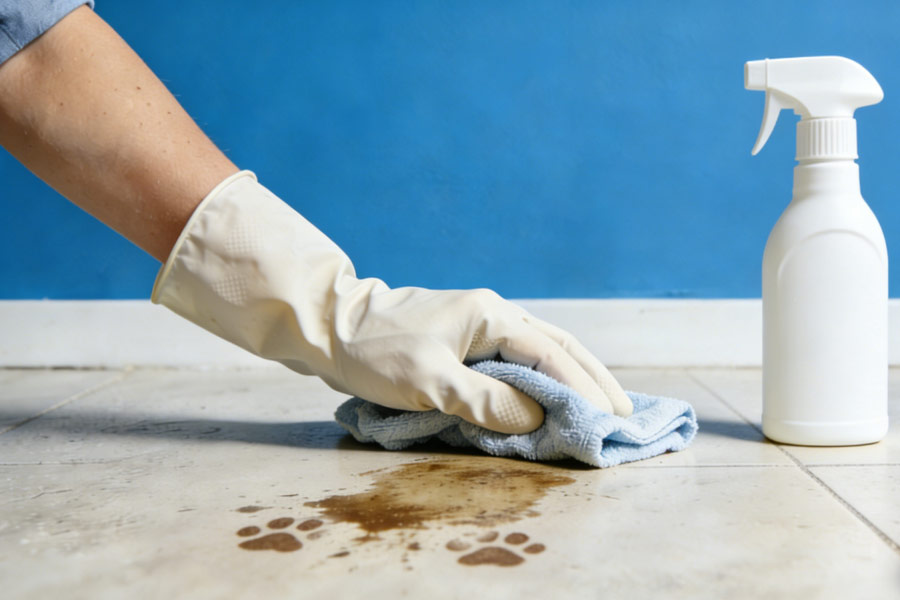
If you’ve ever used bleach, you may have noticed that the cat urine smell temporarily disappears, only to become worse shortly afterward. This is because the chlorine in bleach reacts with uric acid to produce a more pungent chloramine gas—a classic case of “good intentions gone wrong.”
How to Get Rid of Cat Urine Smell Permanently: The Only Weapon That Works
The only truly effective weapon is an enzyme cleaner. After trying dozens of products on the market, I discovered a harsh truth: 95% of “deodorizers” are just fancy perfumes—they mask urine odors with strong floral scents, tricking you into thinking the problem is solved.
What truly changed my perspective was seeing the microscopic view for the first time: enzyme molecules act like tiny “scavengers,” specifically targeting uric acid crystals and breaking them down into harmless water and carbon dioxide. This is the only way to permanently remove cat urine smell.
If you’re searching for how to get rid of cat urine smell, permanently, enzyme cleaners are currently the only scientifically proven effective option. The reason is simple:
How Enzymes “Eat” Odor: The Science of Smell Removal
Using biological enzymes as “specialized decomposers,” stubborn odor compounds in cat urine (primarily uric acid crystals) are thoroughly broken down into odorless, harmless small molecules, achieving a root-cause, permanent deodorizing effect.
Imagine the uric acid crystals in cat urine as a complex lock. Ordinary cleaners attempt to break it open with brute force (often failing), while enzymes act like a specially designed key. Specific proteases, lipases, and amylases precisely break down the organic compounds in urine, transforming them into odorless, harmless basic substances.
Choosing the Right Enzyme Cleaner: A Buyer’s Guide
- Look For This: “Enzymes” in the Ingredient List: It must contain “enzymes,” preferably a multi-enzyme complex formula.
- Pro Tip: Higher Concentration = Better Cat Urine Odor Removal: Don’t be fooled by large bottles. While high-concentration products are pricier, they require less usage and deliver better results.
- Avoid These: “Fragrance” or “Masking” on the Label: “Fragrance,” “masking,” “instant results”—these typically indicate perfume-based products.
- Professional-grade vs. household-grade: For old, set-in stains, investing in one bottle of professional-grade enzyme cleaner (from pet stores or specialized cleaning brands) is more cost-effective and efficient than buying five bottles of household products.
Alright, now we know our enemy and have the right tools. Next comes the real battle—follow this step-by-step process for cat urine smell removal, and even the most stubborn old stains can be saved.
Remove Cat Urine Smell: Your Step-by-Step Blueprint
Here is a complete, step-by-step method for thoroughly removing cat urine odors and stains—what I call the “Cat Urine Elimination Protocol.” While it requires patience, each step serves a critical purpose. I once successfully eradicated a three-year-old stain using this method. The carpet showed its age, but the cat odor vanished completely.
You will need: a bottle of genuine enzyme cleaner, white vinegar, baking soda, clean towels, and a spray bottle. Most crucially, remember: don’t rush. Allow the enzymes enough time to work, and they will reward you with a space that is completely free of pet odors.
1Step 1: Locate and Neutralize – The Critical First 24 Hours
If you discover fresh cat urine stains:
- Blot immediately: Press firmly with a dry towel—remember to press, not rub, or you’ll push the urine deeper into the fabric.
- Neutralize initially: Lightly spray with a 1:1 white vinegar and water solution, let sit for 10 minutes, then blot dry. White vinegar neutralizes the alkaline properties of cat urine.
or old cat urine stains of unknown origin:
- Locate it: Shine a UV light (black light) in a dark area—cat urine stains will fluoresce. No UV light? Then rely on your nose—crouch down and sniff carefully.
- Mark the area: Use chalk or tape to outline an area larger than the visible stain, as urine spreads.
2Step 2: The Enzyme Soak – How to Get Cat Urine Smell Out for Good
- Soak, don’t spray: Pour a generous amount of enzyme cleaner over the cat urine-soaked area until it’s completely saturated and extends 2-3 inches beyond the edges. Yes, use enough that it feels like “wasteful”—surface dampness doesn’t mean deep fiber saturation.
- Cover with plastic wrap: Tightly seal the area with plastic wrap, securing the edges with weights. This step is crucial—it prevents the enzyme cleaner from evaporating, maintaining a moist environment for the enzymes to work continuously.
- Wait patiently: Allow at least 24-48 hours. For old stains, up to 72 hours may be needed. I know it’s agonizing, but this is the only way to effectively remove cat urine smell.
- Do not disturb: Do not lift the plastic wrap to check during this period, and do not add any other cleaning agents.
Many people fail at this step because they can’t resist checking after 12 hours. Remember, the scientific approach to eliminating cat urine odor means respecting the timing of biochemical reactions—just as fermenting dough requires resting, enzymatic breakdown is a slow process you cannot rush. You must simply wait patiently.
3Step 3: Rinse and Dry – Ensuring the Cat Urine Smell Doesn’t Return
- Remove plastic wrap: Use a dry towel to absorb excess cleaner.
- Rinse with water: Gently rinse the area with clean water (preferably lukewarm) to remove any residue from the breakdown.
- Re-absorb moisture: Use a dry towel to absorb as much moisture as possible.
- Thoroughly dry: Direct a fan toward the area or maintain good ventilation indoors. Complete drying may take 1-3 days. Do not cover or use the area until it is completely dry.
4Step 4: Verify – How to Know the Cat Urine Smell is Gone Permanently
How to Tell if Cat Urine Odor Has Been Completely Removed?
- Smell Test: After the area is completely dry, bring your nose close and take a deep breath. If you detect even a hint of ammonia, repeat Step 2.
- Steam Test: Hold a steam iron a few inches above the surface and release a burst of steam. The high heat and humidity will make any remaining uric acid crystals visible.
- If the test passes, sprinkle baking soda over the area, let it sit for several hours, then vacuum it up as a final precaution.
Strictly follow the four steps outlined above to ensure odors and stains are completely eliminated at the source. (For a dedicated guide focused solely on erasing those stubborn yellow marks, see our step-by-step tutorial on how to clean urine stains.)
How to Get Cat Urine Smell Out of Anything: Surface-by-Surface Guide
I know you might be thinking, “But my problem is with the sofa/mattress/wooden floor!” Don’t worry—the complete steps above for “how to get rid of cat urine smell—Step-by-Step Guide” apply to all surfaces. Just fine-tune the details, and we have dedicated guides for each. While the core method for removing cat urine odor remains the same, different materials require some adjustments:
For Carpets & Rugs: Maximize Soaking, Ensure Deep Drying
Easiest to treat, as you can use plenty of liquid without worrying about damage. Note that treatment may be needed from the back side as well.
For Mattresses: Targeted Application, Prevent Soaking
Never soak the mattress. Use a moderate amount of enzyme cleaner and seal it with plastic wrap for longer treatment (see our [Mattress Cat Urine Cleaning Guide] for detailed steps).
For Couches & Upholstery: Test First, Inject if Needed:
Test fabric colorfastness on an inconspicuous spot first. You may need to inject cleaner into the padding using a syringe.
For Hardwood Floors: Act Fast, Minimal Moisture
Act quickly to prevent urine from seeping into floorboards. Typically requires minimal cleaning.
For Clothes & Fabrics: Pre-Treat, Then Wash in Cold Water
Pre-treat machine-washable items with enzyme cleaner; hand-soak non-washable items (see our [Clothing Deodorizing Guide] for details).
Stop Cat Urine Problems Before They Start: Fixing the Root Cause
I’ve seen too many people punish their cats angrily after solving the cat urine odor problem. But please understand—cats aren’t seeking revenge. Their behavior almost always has a reason, and identifying that reason is more important than any cleaning effort.
An animal behaviorist once told me: “Ninety percent of cats’ inappropriate urination stems from environmental or health issues; only ten percent is behavioral.” After successfully removing cat urine odors and stains, take the time to address the root cause:
- Primary Check: Health Issues
- Sudden urination accidents often signal urinary tract infections, diabetes, or kidney disease.
- Take your cat to the vet immediately to rule out medical causes.
- Litter Box Issues (Most Common Cause)
- Cleanliness: Scoop daily and replace litter completely weekly.
- Quantity: Multi-cat households need N+1 litter boxes (e.g., 4 boxes for 3 cats).
- Location: Quiet, private, and easily accessible
- Litter Type: Some cats dislike certain textures or scents
- Environmental Stressors
- New pets, family members, furniture, or even unfamiliar stray cats outside
- Provide vertical space (cat trees), hiding spots, and consistent routines
- Marking Behavior
- Unneutered cats are more likely to engage in cat spraying to mark their territory. (This is especially true for male cats. To understand why male cats spray and how to stop it, read our in-depth analysis here.)
- Neutering resolves 90% of marking issues.
Successfully removing cat urine odors and stains is a major accomplishment, but it’s only half the battle. If you don’t address the root cause of your cat’s inappropriate urination, you’ll likely get stuck in an exhausting cycle of “clean → mess → clean.”I strongly recommend checking out our other ultimate guide: Solving the Problem of Cats Peeing Outside the Litter Box.
Now you know where the enemy lies (uric acid crystals), you know the right weapon (enzyme cleaner), and you know the battle plan (soak, seal, wait). You’re practically a cat urine removal expert already.
Removing cat urine odors—permanently remove cat urine smell—requires the right knowledge, not endless physical effort. This method might not be the shortest you’ve read, but it’s the only truly effective solution I’ve distilled after years of trial, error, and success.
Remember the three core principles: enzymes, soaking, patience.
Common Mistakes in Cat Urine Smell Removal
Q: Does Vinegar Remove Cat Urine Smell?
A: Vinegar can only neutralize the alkalinity of fresh cat urine, but it is completely ineffective against already formed uric acid crystals. It’s a good initial treatment, but not the ultimate solution for cat urine smell.
Q: What About Baking Soda for Cat Urine Odor?
A: Baking soda is an excellent odor absorber, but it doesn’t break down the smell. It can serve as a final “insurance” step to remove cat urine smell or control odors between cleanings, but it won’t solve the problem on its own.
Q: Do Store-Bought “Pet Odor Sprays” Work on Cat Urine?
A: Most are just fragranced products. Check the ingredient list—if it doesn’t specify enzyme types, it likely just masks odors. Genuine enzyme cleaners rarely emphasize “pleasant scent” because they focus on breaking down uric acid crystals in cat urine, not masking smells.
Q: Can Old Cat Urine Stains and Smell Be Removed?
A: Absolutely. Even years-old stains can be restored if uric acid crystals remain—enzymes can break them down. It may require longer soaking times and increased cleaner application, but following our scientifically proven cat urine removal process guarantees recovery.
Q: Should I Throw Away Furniture with Cat Urine Smell?
A: Don’t give up before trying a thorough enzyme clean. I’ve seen countless carpets and sofas deemed “hopeless” successfully restored. Only consider replacement if the internal padding (like foam) is completely saturated with cat urine and cannot dry out.
Related Articles
-
-
-
 Do Female Cats Spray? The Complete Guide to Why & How to Stop It Wondering if female cats spray? The answer is yes. Discover the surprising reasons why female cats spray, how it differs from male cats, and proven methods to stop this behavior. Get answers to “can female cats spray?” and “do girl cats spray?” here.
 -